


A patent is a legal right granted by a government to an inventor for a new and useful invention. This exclusive right allows the inventor to prevent others from making, using, selling, or distributing the invention without permission for a specific period, usually 20 years from the filing date. The primary purpose of a patent is to encourage innovation by rewarding inventors for their creativity and investment in research and development.
In today’s competitive world, protecting intellectual property has become increasingly important. Businesses, startups, researchers, and individual inventors rely on a patent to secure their inventions and maintain a competitive advantage. By obtaining legal protection, inventors can commercialize their ideas without fear of unauthorized copying. A patent not only protects innovations but also contributes to technological progress and economic growth by encouraging new discoveries and inventions.
Understanding the Concept of Patent
A patent is a form of intellectual property protection that grants exclusive rights to the inventor of a novel invention. These rights are provided by a government authority after examining the invention to ensure it meets specific legal requirements.
The invention must generally satisfy three major conditions:
- It must be new or novel.
- It must involve an inventive step.
- It must have industrial applicability.
Once approved, the inventor receives exclusive control over the invention for a defined period. During this time, no other person or organization can legally exploit the invention without authorization. This exclusivity encourages innovation by allowing inventors to recover research and development costs and generate profits from their creations.
The patent system balances the interests of inventors and society. While inventors receive exclusive rights, they are also required to disclose technical details of their invention, allowing others to learn from the innovation and contribute to future technological advancements.
History and Evolution of Patent Laws
The concept of protecting inventions dates back centuries. Early forms of patent rights were granted in various civilizations to encourage craftsmanship and innovation. One of the earliest documented patent systems emerged in Venice during the fifteenth century.
Over time, countries around the world developed their own legal frameworks for protecting inventions. The Industrial Revolution accelerated the importance of patent laws as technological innovation became a major driver of economic growth. Governments recognized the need to create systems that rewarded inventors while encouraging public disclosure of technological knowledge.
Modern patent systems have evolved to accommodate complex technologies, including software, biotechnology, pharmaceuticals, and artificial intelligence. International agreements have also helped standardize patent protection across different countries, making it easier for inventors to protect their innovations globally.
Today, patent laws continue to adapt to emerging technologies and changing economic conditions, ensuring that innovation remains protected in an increasingly interconnected world.
Types of Patent
Different inventions require different forms of protection. Patent systems generally provide several categories of patents.
| Type of Patent | Purpose |
|---|---|
| Utility Patent | Protects functional inventions and processes |
| Design Patent | Protects ornamental designs and appearance |
| Plant Patent | Protects newly discovered plant varieties |
| Provisional Patent | Provides temporary protection before full filing |
Utility patents are the most common and cover machines, manufacturing processes, compositions, and technological innovations. Design patents focus on the visual appearance of products rather than their functionality.
Plant patents protect new plant varieties developed through scientific methods. Provisional applications offer inventors an opportunity to establish an early filing date while preparing a complete application.
Understanding these categories helps inventors choose the appropriate form of protection for their innovations.
Importance of Patent Protection
The importance of a patent extends beyond legal ownership. It serves as a valuable business asset that can significantly influence commercial success.
Patent protection helps inventors:
- Prevent unauthorized copying.
- Increase market competitiveness.
- Attract investors and funding.
- Generate licensing revenue.
- Enhance company valuation.
- Support business expansion.
Many investors consider intellectual property portfolios when evaluating businesses. A strong patent portfolio demonstrates innovation and creates barriers for competitors. Companies often license patented technologies to other organizations, creating additional income streams.
Moreover, patent protection fosters confidence among inventors by ensuring that their efforts and investments receive legal recognition and protection.
Requirements for Obtaining a Patent
Not every invention qualifies for patent protection. Patent offices carefully evaluate applications based on specific criteria.
Novelty
The invention must be completely new and not publicly disclosed before the filing date.
Inventive Step
The invention should not be obvious to someone with expertise in the relevant field.
Industrial Applicability
The invention must have practical utility and be capable of being used in industry.
Patentable Subject Matter
Certain categories may not qualify for protection, depending on national laws. Examples can include abstract ideas, natural phenomena, and mathematical formulas.
Meeting these requirements is essential for obtaining successful patent registration and long-term protection.
Patent Application Process
The process of obtaining a patent involves several important stages. Although procedures vary by country, the general framework remains similar.
Step 1: Conduct a Patent Search
Inventors should search existing databases to determine whether similar inventions already exist.
Step 2: Prepare Documentation
Detailed descriptions, drawings, claims, and technical information must be prepared carefully.
Step 3: File the Application
The application is submitted to the appropriate patent office.
Step 4: Examination
Patent examiners review the application and assess compliance with legal requirements.
Step 5: Publication
The application is published for public review after a specified period.
Step 6: Grant of Patent
If all requirements are satisfied, the patent is granted and legal protection begins.
This process may take several months or years depending on the complexity of the invention and examination procedures.
Benefits of Holding a Patent
Obtaining a patent offers numerous advantages for inventors and businesses. These benefits often justify the time and financial investment required during the application process.
Some major benefits include:
- Exclusive market rights.
- Protection against competitors.
- Improved business reputation.
- Increased licensing opportunities.
- Potential for higher profits.
- Attraction of venture capital.
- Enhanced technological leadership.
A patent transforms an innovative idea into a legally protected asset. This asset can be sold, licensed, transferred, or used strategically in business negotiations.
For startups especially, strong intellectual property protection can be a key factor in achieving long-term growth and success.
Challenges Associated with Patent Protection
While patents offer significant benefits, they also present certain challenges.
The application process can be expensive and time-consuming. Inventors must often hire specialized professionals to prepare technical documentation and respond to examination objections. International patent protection may require multiple applications across different jurisdictions, increasing costs further.
Another challenge involves enforcement. Holding a patent does not automatically stop infringement. Patent owners may need to pursue legal action against unauthorized users, which can involve substantial expenses.
Additionally, rapid technological changes sometimes create uncertainty regarding the scope and interpretation of patent rights. Businesses must continuously monitor their intellectual property portfolios to maintain effective protection.
Despite these challenges, patents remain one of the most valuable tools for safeguarding innovation.
Patent vs Copyright vs Trademark
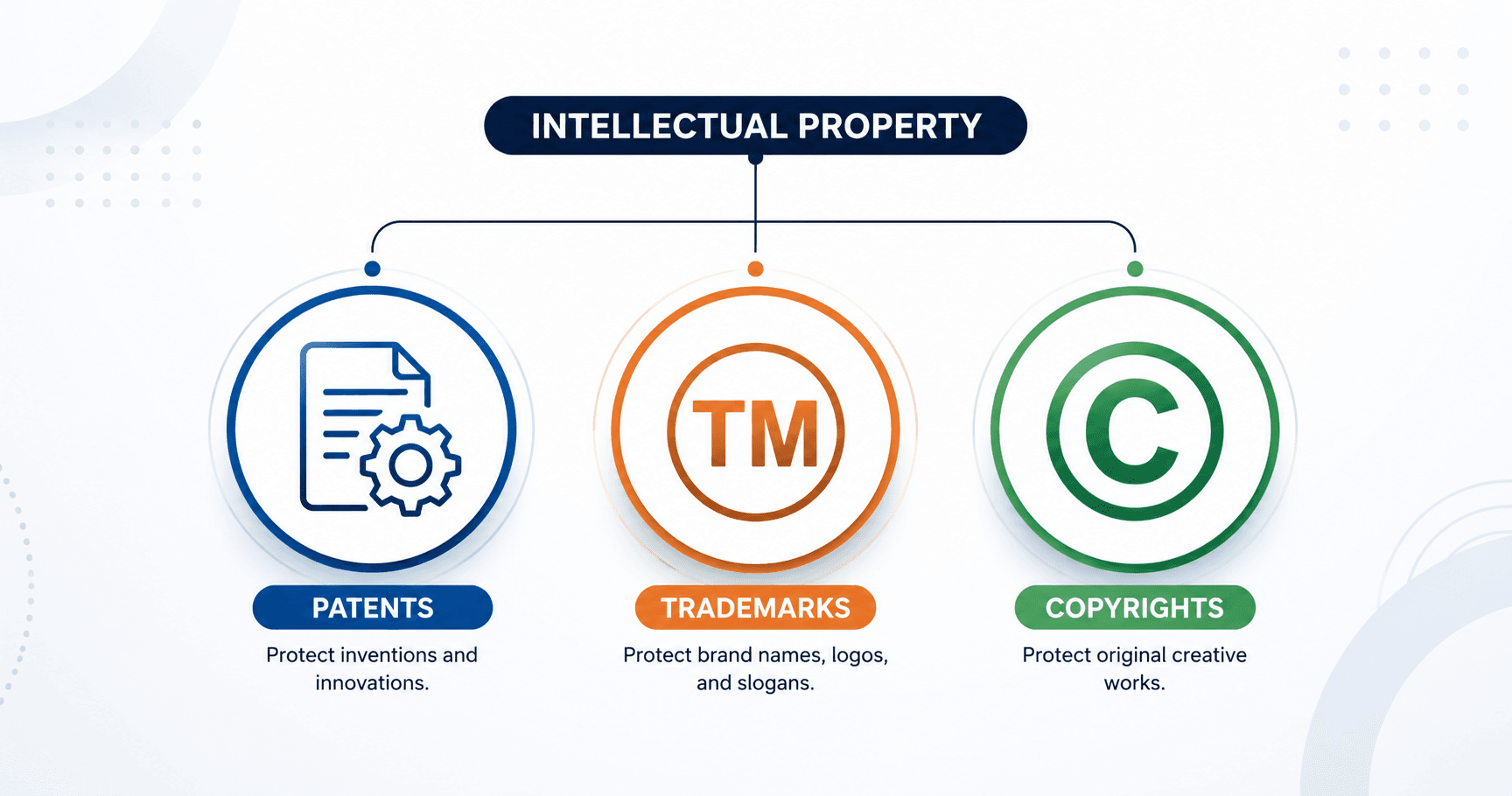
Intellectual property protection includes several different legal mechanisms. Understanding their distinctions is important.
| Feature | Patent | Copyright | Trademark |
|---|---|---|---|
| Protects | Inventions | Creative Works | Brand Identity |
| Duration | Usually 20 Years | Lifetime + Additional Years | Renewable Indefinitely |
| Registration | Required | Often Automatic | Registration Recommended |
| Example | New Machine | Book or Song | Company Logo |
Each form of protection serves a unique purpose. Inventors often combine multiple intellectual property rights to achieve comprehensive legal protection.
Future of Patent Systems
Technological advancements continue to reshape the patent landscape. Emerging fields such as artificial intelligence, biotechnology, renewable energy, and quantum computing are generating complex legal questions.
Patent offices worldwide are adapting examination procedures to address these innovations. Digital filing systems, international cooperation, and harmonized standards are improving efficiency and accessibility.
The growing importance of knowledge-based economies means that patent protection will remain a central element of innovation policy. Governments, businesses, and researchers increasingly recognize the role of intellectual property in driving economic development and technological progress.
As global competition intensifies, effective patent systems will continue supporting inventors while encouraging public access to valuable technological information.
Conclusion
A patent is a powerful legal tool that protects inventions and encourages innovation. By granting exclusive rights to inventors, the patent system promotes research, technological advancement, and economic growth. Whether created by an individual inventor, a startup, or a multinational corporation, a patent helps secure ownership of valuable ideas and provides opportunities for commercialization and investment.
Read more: Attorney General of India